Filing a Malaysian Tax Return as a Foreigner: Form BE or M, Deadlines and Leaving Malaysia
Updated Sat, 21 November 2026
Estimate your Malaysian income tax first →If you work in Malaysia, you file a Malaysian income tax return each year, whatever your passport says. Which form you use depends on your tax residence, not your nationality: residents file Form BE (or Form B if they have business income) and non-residents file Form M. The Inland Revenue Board (LHDN, also called HASiL) set out these rules for foreign employees in Public Ruling No. 2/2026, published on 27 March 2026.
This guide covers which form you need, the deadlines, the short-assignment exemption, how to file online, and what happens to your tax when you leave Malaysia.
Which form, and by when?
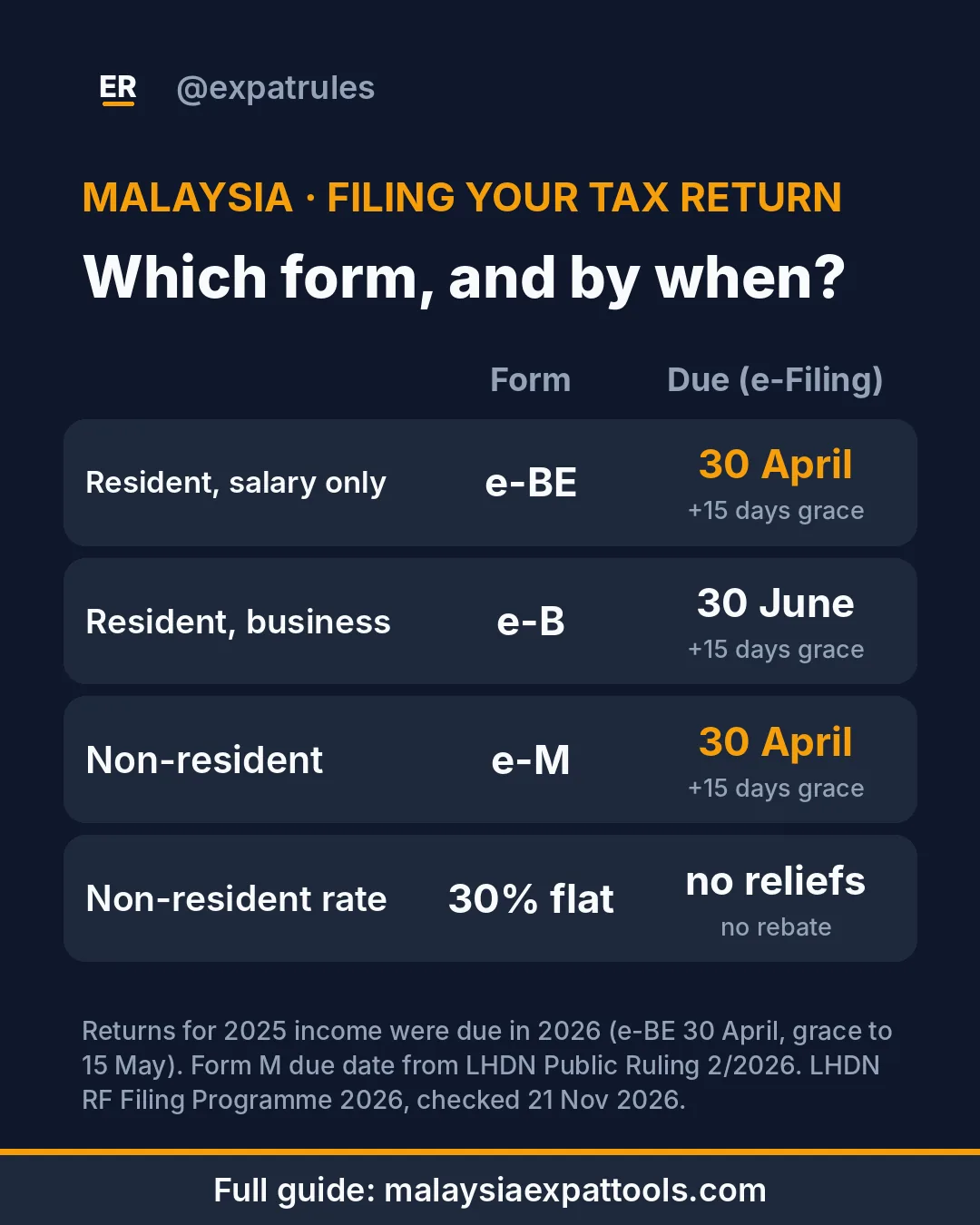
You file in the year after you earn the income. Returns for 2025 income (year of assessment 2025) were due in 2026. LHDN’s Return Form Filing Programme for 2026 set these dates:
| Your situation | Form | Due date | Late after (e-Filing) |
|---|---|---|---|
| Resident, no business income (for example a salaried employee) | BE | 30 April 2026 | 15 May 2026 |
| Resident with business income | B | 30 June 2026 | 15 July 2026 |
| Non-resident | M | 30 April | plus 15 days |
- The grace period only applies to e-Filing. LHDN treats an e-Filed return as on time if it arrives within 15 days of the due date. Its own example: Form e-BE is due on 30 April 2026, the grace period runs to 15 May 2026, and a return filed on 16 May is late. The grace period also covers paying any balance of tax for e-Filed returns.
- Form M: the filing programme gives e-M the same 15-day grace period, and Public Ruling 2/2026 says the return is due “on or before 30th April in the following year”. If you are a non-resident with business income, check the current programme for your date.
- Late returns can lead to action or a penalty under section 112 of the Income Tax Act 1967.
Returns for 2026 income are due in 2027. LHDN publishes each year’s filing programme around the turn of the year, so check the new dates before you file.
Resident or non-resident?
Residence is about days in Malaysia. Most people become residents by spending at least 182 days in Malaysia in the calendar year, and there are three other tests that link years together. The 182-day counter adds up your days, and the tax residency guide explains all four tests.
It changes your bill a lot:
- Residents pay rates from 0% to 30% on chargeable income, after reliefs such as the RM9,000 individual relief.
- Non-residents pay a flat 30% on every ringgit of chargeable income, with no personal reliefs and no rebate.
The income tax calculator shows both, and the income tax guide has worked examples.
Do you need to file at all?
LHDN says you must register a tax file once your taxable income exceeds the threshold. For employment income, it says people who earn more than RM37,333 a year and have monthly tax deductions (MTD, often called PCB) taken from their pay are taxable. Your employer deducts MTD each month, but that does not replace the return: the return is where your final tax for the year is worked out and any difference is paid or refunded.
Your employer must give you your Form EA (C.P.8A), the yearly statement of your pay and deductions, by the end of February. You need it to fill in the return.
Short assignments: the 60-day exemption
If you are a non-resident and your employment in Malaysia lasts 60 days or less in a calendar year, the income from that work is exempt (paragraph 21 of Schedule 6 of the Income Tax Act). Public Ruling 2/2026 adds three points:
- It counts days of employment in Malaysia, not days of physical presence. Weekends or holidays spent in Malaysia do not count against you, but working days do.
- A stretch that runs across two calendar years is added together. If one continuous period overlaps the year end and goes over 60 days, the exemption is lost.
- It is not automatic. You claim it on your return and must be able to prove you qualify. In the ruling’s own example, a 61-day assignment does not qualify.
Foreign tax and double tax treaties
If the same income is also taxed abroad, a double tax agreement may give you a credit. Under Public Ruling 2/2026, the bilateral credit is only for foreign nationals who are Malaysian tax residents for that year. Where there is no treaty, a unilateral credit of up to half of the foreign tax may be available. Foreign income you bring into Malaysia is a separate question: see the foreign income guide.
How to file online
LHDN’s filing steps for non-residents work the same way for residents:
- Go to the MyTax portal (mytax.hasil.gov.my) and log in with your identification type, number and password. If you do not have a tax number yet, register first through e-Daftar on the same portal.
- Choose ezHasil Services, then e-Filing, then e-Form.
- Pick the year of assessment and the form: e-BE, e-B or e-M.
- Fill in your particulars, income and, if you are a resident, your reliefs. Check the summary, then sign and submit.
Leaving Malaysia: tax clearance
This is the part foreigners most often miss. When you leave, your employer has to tell LHDN before your last pay goes out:
- Form CP21 must be submitted at least 30 days before you are expected to leave Malaysia. Since 1 January 2024 it is filed online through MyTax (e-SPC).
- If you stop working, the employer also submits Form CP22A (private sector) at least 30 days before your job ends.
- The employer must hold back money it owes you until LHDN issues a tax clearance letter. For a job that ends (CP22A), LHDN’s page says the money cannot be paid without its permission until 90 days after it receives the form. Employers who do not comply can be fined RM200 to RM20,000, imprisoned for up to six months, or both, and are liable for tax the employee leaves unpaid.
- The employer does not need to submit CP21 or hold back pay if your trips abroad are a regular part of the job.
If you are leaving Malaysia for good and have no more taxable income, you can ask LHDN to close your tax file with a written application to the office that handles it. First make sure no tax is owed and no refund is still pending.
Plan for this in your notice period: ask HR when they will file CP21, and make sure your last return is in so the clearance is not held up.
Checklist
- Work out your residence status for the year (182 days and the other tests).
- Collect your Form EA by the end of February.
- File the right form on MyTax: BE (resident), B (resident with business) or M (non-resident).
- File by 30 April (30 June for Form B). The 15-day grace period only helps if you e-File.
- Leaving? Give HR at least 30 days so they can file CP21, and expect your final pay to wait for tax clearance.
This guide is general information, not tax advice. If your case involves business income, a treaty claim or a move part-way through the year, check with LHDN or a tax adviser.
Sources
- LHDN Public Ruling No. 2/2026: Tax Treatment of Foreign Nationals Exercising Employment in Malaysia (published 27 March 2026; Form BE, B or M, 30 April, flat 30%, 60-day exemption, treaty relief)
- LHDN: Return Form (RF) Filing Programme for the Year 2026 (updated 1 April 2026; due dates, 15-day e-Filing grace period, Form EA by 28 February)
- LHDN: income tax return form deadlines (BE 30 April, e-BE 15 May; B 30 June, e-B 15 July)
- LHDN: introduction to individual income tax (RM37,333 employment income with MTD; last updated 19 November 2026)
- LHDN: Tax Treatment, Residents and Non-Residents, with e-M filing steps
- LHDN: notification of cessation of employment (CP21, CP22A) (30 days, 90 days, penalties; last updated 8 September 2026)
- LHDN: termination of service and closing a tax file
This guide is general information, not legal or tax advice. Rules change, so confirm with the Immigration Department, LHDN or a professional.