Malaysia Foreign-Sourced Income Exemption: Is Money From Abroad Taxed? (to 2036)
Updated Sat, 7 November 2026
Check your foreign income →Since 2022, foreign income that a Malaysian tax resident brings into Malaysia has been taxable in principle. In practice, individuals are exempt until 31 December 2036, as long as a few conditions are met. This guide explains who gets the exemption, what “subject to tax” means, and the cases where foreign money is still taxed. It is based on the Inland Revenue Board (LHDN) guideline on income received from abroad (June 2024) and the order that extended the exemption to 2036.
The short answer
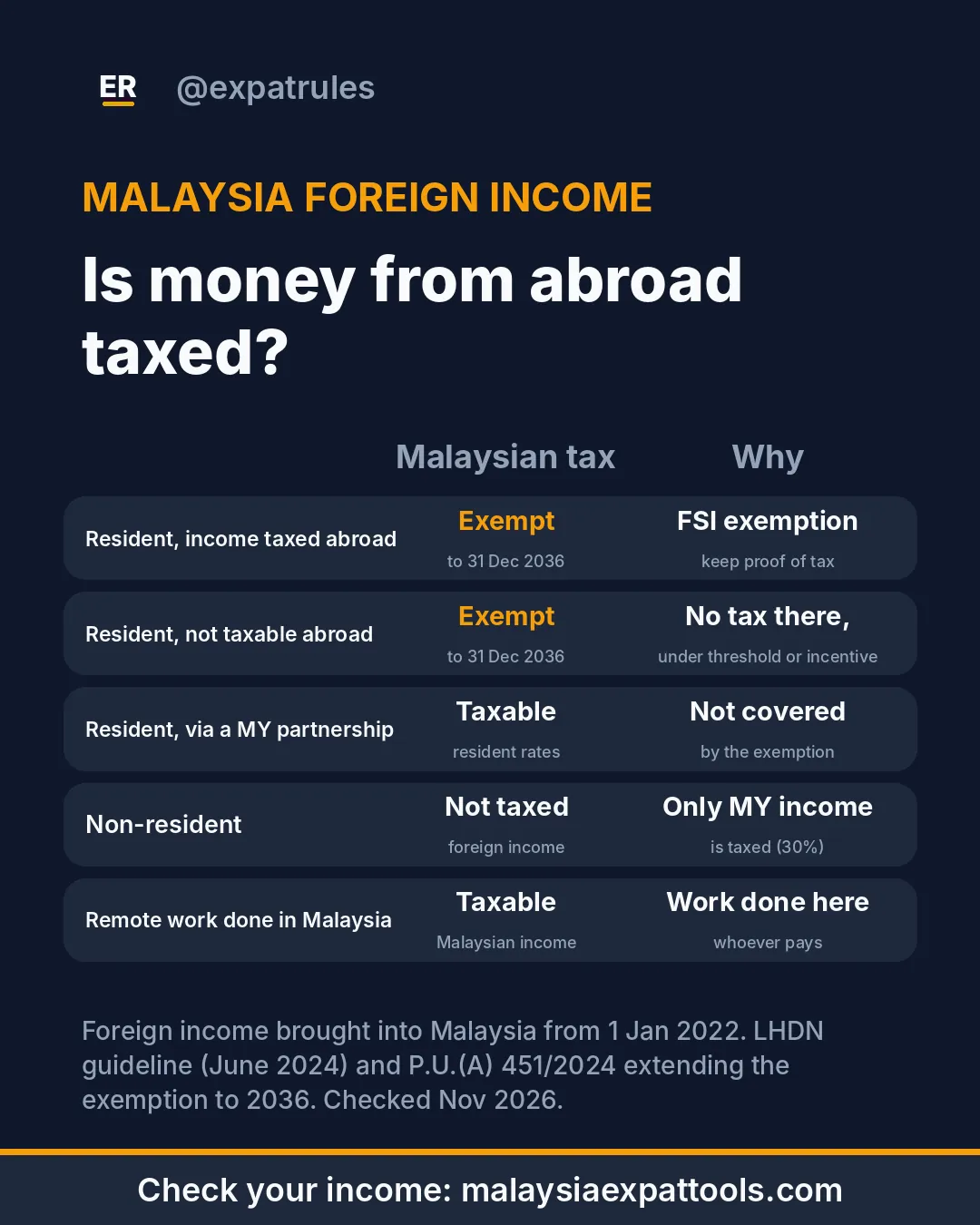
- Resident individuals: foreign income brought into Malaysia from 1 January 2022 to 31 December 2036 is exempt, if it was subject to tax in the country it came from.
- Non-residents: not taxed on foreign income at all. They pay tax only on Malaysian income, at a flat 30% on employment income.
- Not covered: foreign income received through a partnership business in Malaysia.
- Not foreign income: pay for work you do while you are in Malaysia, even if a foreign employer pays it into a foreign account.
Who gets the exemption
The exemption is for an individual who is resident in Malaysia for the year under the Income Tax Act 1967. Residence depends on the days you spend in Malaysia, not on your visa. If you are unsure, see the 182-day tax residency guide or use the day counter.
The LHDN guideline was written when the exemption ran to 31 December 2026. An order gazetted on 24 December 2024, P.U.(A) 451/2024, extended it to 31 December 2036 for resident individuals, effective 1 January 2027.
What income is covered
All kinds of foreign income received by a resident individual, except partnership income:
- employment income for work done abroad
- business profits from abroad
- dividends, interest and rent
- royalties and pensions
- other foreign income
LHDN’s own examples include salary from a job in Singapore brought into Malaysia by someone who commutes daily from Johor Bahru, and employment income from Brunei, which Brunei does not tax. Both are exempt.
The “subject to tax” condition
The income must have been subject to tax in the country it came from. LHDN treats the condition as met when:
- tax was paid or is payable there, as income tax or withholding tax, or
- no tax was charged because that country does not tax this kind of income, because your income is below its tax-free level, or because of a tax incentive there.
For dividends, the condition can also be met through the tax paid by the company on the profits behind the dividend.
If the income could have been taxed abroad but was not, for example because it was never declared there, the exemption may not apply. Ask a tax adviser before you file.
What counts as bringing money into Malaysia
Foreign income is only relevant when it is received in Malaysia. LHDN says income is received when it is brought or transferred into Malaysia in cash or by electronic transfer. Electronic transfer is wide. It includes:
- bank transfers
- debit, credit and charge card payments
- e-money
- cryptoassets and stablecoins
So paying a Malaysian bill with a foreign credit card can count as bringing foreign income in. Under the exemption this usually makes no difference for a resident individual, but it matters if you fall outside the exemption.
Remote work is not foreign income
The most common mistake among expats is treating a remote salary as foreign income. If you do the work while physically in Malaysia, the pay is Malaysian-sourced income, wherever your employer is and wherever the money lands. A resident pays the normal progressive rates on it; a non-resident pays a flat 30%. See the income tax guide for foreigners or the income tax calculator.
The 2% dividend tax
From year of assessment 2025, Malaysia taxes dividends above RM100,000 a year at 2%. That tax is for dividends from Malaysian companies. Foreign dividends received by a resident individual stay under the exemption until 2036.
Records to keep and how to declare
Even exempt income has to be reported. LHDN asks individuals to declare in the tax return:
- the type and amount of foreign income
- the country it came from
- the foreign tax charged on it, or the reason no tax was charged
Keep the papers that prove it, such as foreign tax assessments, payslips, dividend vouchers and withholding tax statements, in case LHDN audits you. Expenses linked to exempt foreign income cannot be deducted.
After 2036
Unless the government extends it again, foreign income received by resident individuals from 1 January 2037 will be taxable, with credit for tax paid abroad where the rules allow. Non-residents will still not be taxed on foreign income.
Before you rely on it
This guide covers individuals only; companies and partnerships have stricter rules. If large sums are involved, or the income was not taxed abroad, get advice from a Malaysian tax adviser. To check one type of income quickly, use the foreign income exemption checker.
Sources
- LHDN: Guidelines on Tax Treatment in relation to Income Received from Abroad (Amendment), June 2024 (residents, partnership exception, “subject to tax”, received in Malaysia, records)
- Bloomberg Tax: Malaysia gazettes order extending the foreign income exemption (P.U.(A) 451/2024)
- The Edge: Budget 2025 extends the FSI exemption to 2036
- PwC Worldwide Tax Summaries: Malaysia, income determination
- ACCA: Finance Act 2024 Malaysia, part 2 (dividend tax)
- LHDN: Tax rates
This guide is general information, not legal or tax advice. Rules change, so confirm with the Immigration Department, LHDN or a professional.