Malaysia Tax Residency: The 182-Day Rule and the 3 Other Tests
Updated Sat, 31 October 2026
Count your days in Malaysia
Add each stay in Malaysia, including past years if you have them. The counter adds up your days for every calendar year, counting arrival and departure days, checks the 182-day, linked-stay and 90-day tests, and tells you how many days you have left this year before you reach 182.
All years
| Year | Days in Malaysia | Status |
|---|
The counter does not add back short trips abroad that LHDN allows inside a linked stay (see test 2 below), and it cannot check test 4, which depends on the following year. Your dates are counted in your browser and are not sent anywhere.
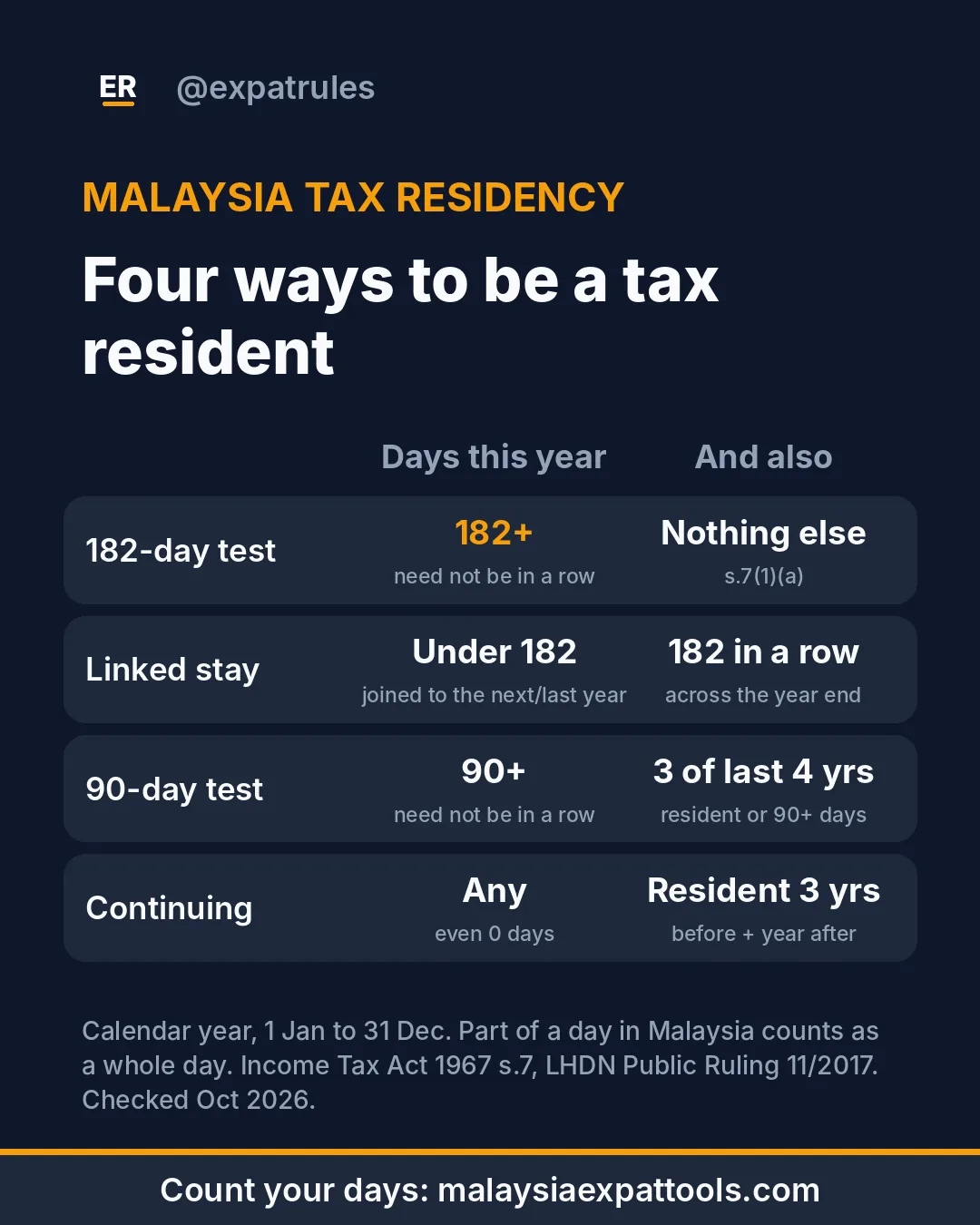
You become a Malaysian tax resident if you spend 182 days or more in Malaysia in a calendar year, counting the days you arrive and leave. With fewer days, three other tests can still make you resident.
Your Malaysian tax bill depends less on your visa than on how many days you spend in the country. A tax resident pays progressive rates from 0% and can claim personal reliefs. A non-resident pays a flat 30% on Malaysian employment income with no reliefs (see Malaysia income tax for foreigners for the rates and examples). This guide explains the four residence tests in section 7 of the Income Tax Act 1967, as set out by the Inland Revenue Board (LHDN) in Public Ruling 11/2017.
The short answer
- The year is the calendar year, 1 January to 31 December.
- 182 days or more in that year makes you resident. The days do not have to be in a row.
- With fewer days, three other tests can still make you resident.
- Your pass does not decide it. MM2H, DE Rantau, an Employment Pass and a tourist entry are all treated the same way: only the days count.
How days are counted
LHDN’s Public Ruling 11/2017 says you are treated as present in Malaysia for a whole day if you are here for part of that day. So the day you arrive and the day you leave both count as days in Malaysia. A trip from 1 to 10 March is 10 days, not 9.
Test 1: 182 days in the year (section 7(1)(a))
If your days in Malaysia add up to 182 or more in the calendar year, you are resident for that year. Several shorter stays add together: 100 days in spring and 90 days in autumn make 190 days.
This is the test most expats rely on. If you are close to the line, the 182-day counter at the top of this page adds up your stays and tells you how many days you have left.
Test 2: the linked stay (section 7(1)(b))
You can be resident with fewer than 182 days in a year if those days are part of an unbroken stay of 182 days or more in a row that runs into the year before or the year after.
Example: you arrive on 1 October 2026 and stay until 30 April 2027. You have only 92 days in 2026, but they are part of a continuous stay of more than 182 days that carries on into 2027, so you can be resident for 2026 as well as 2027.
Trips abroad that do not break the stay
Some short absences count as part of the unbroken period, as long as you are in Malaysia immediately before and after the trip. LHDN lists:
- absence connected with your job in Malaysia, such as work trips, conferences, seminars or study abroad;
- absence because of ill health of you or a member of your immediate family;
- social visits of up to 14 days in total.
A three-week holiday in the middle of the stay is more than 14 days of social visits, so it can break the chain.
Test 3: 90 days plus a history (section 7(1)(c))
You are resident if you spend 90 days or more in Malaysia in the year (not necessarily in a row) and, in any 3 of the 4 years before, you were either resident or in Malaysia for 90 days or more.
This catches long-term expats who now split their time: someone who lived in Malaysia full time from 2022 to 2025 and spends 120 days here in 2026 is still resident for 2026.
Test 4: continuing residence (section 7(1)(d))
You can be resident in a year when you spend few or no days in Malaysia if you are resident for the following year and were resident for each of the 3 years before. It covers a long-term resident who spends a year away and then comes back.
Because it depends on the next year, this test can usually only be settled after that year ends.
Why it matters
| Resident | Non-resident | |
|---|---|---|
| Tax on Malaysian employment income | Progressive, 0% to 30% | Flat 30% |
| Personal relief (RM9,000) and other reliefs | Yes | No |
| Foreign income brought into Malaysia | Exempt until 31 December 2036 under conditions | Not taxed |
On a salary of RM10,000 a month, the gap is large: about RM12,150 a year for a resident with only the personal relief, against RM36,000 for a non-resident. See the Malaysia income tax guide for foreigners for the full rates, or run your own numbers in the income tax calculator.
Being resident also matters for the foreign income exemption: it is a relief for residents, while non-residents are not taxed on foreign income at all.
Common mistakes
- Counting by tax year from your arrival date. Malaysia uses the calendar year, not 12 months from when you arrived.
- Forgetting arrival and departure days. Both count.
- Assuming a long-stay visa makes you resident. An MM2H holder who spends 60 days a year in Malaysia is usually a non-resident for tax.
- Assuming a remote job abroad is foreign income. Work you do while in Malaysia is Malaysian-source income, whoever pays you.
Before you rely on it
The tests have edge cases, especially the linked stay and continuing residence. If you are within a few days of a threshold, keep your passport stamps and travel records, and check with LHDN or a tax adviser.
Sources
- LHDN: Residence Status (Taraf Mastautin) (last updated 10 August 2026)
- LHDN Public Ruling No. 11/2017: Residence Status of Individuals
- CTIM: summary of Public Ruling 11/2017 (part of a day counts as a whole day, paragraph 5)
- LHDN: Tax rates
Frequently asked questions
What is the 182-day rule for tax residency in Malaysia?
If you spend 182 days or more in Malaysia in a calendar year (1 January to 31 December), you are a tax resident for that year under section 7(1)(a) of the Income Tax Act 1967. The days do not have to be in a row, and your type of pass does not change the test.
Do arrival and departure days count towards the 182 days?
Yes. LHDN treats you as present for a whole day if you are in Malaysia for part of that day, so a trip from 1 to 10 March is 10 days, not 9.
Can I be a Malaysian tax resident with fewer than 182 days?
Yes, through three other tests: a stay of 182 days or more in a row that runs into the year before or after, 90 days or more in the year plus residence or 90-day years in any 3 of the 4 years before, or being resident for the following year and each of the 3 years before.
What happens if I am not a tax resident in Malaysia?
A non-resident pays a flat 30% on Malaysian employment income with no personal reliefs. A resident pays progressive rates from 0% to 30% and can claim the RM9,000 personal relief and other reliefs.
Does an MM2H or DE Rantau visa make me a tax resident?
No. MM2H, DE Rantau, an Employment Pass and a tourist entry are all treated the same way: only your days in Malaysia count. An MM2H holder who spends 60 days a year in Malaysia is usually a non-resident for tax.
This guide is general information, not legal or tax advice. Rules change, so confirm with the Immigration Department, LHDN or a professional.