Malaysia Income Tax for Foreigners 2026: Resident Rates vs the Flat 30%
Updated Sat, 28 November 2026
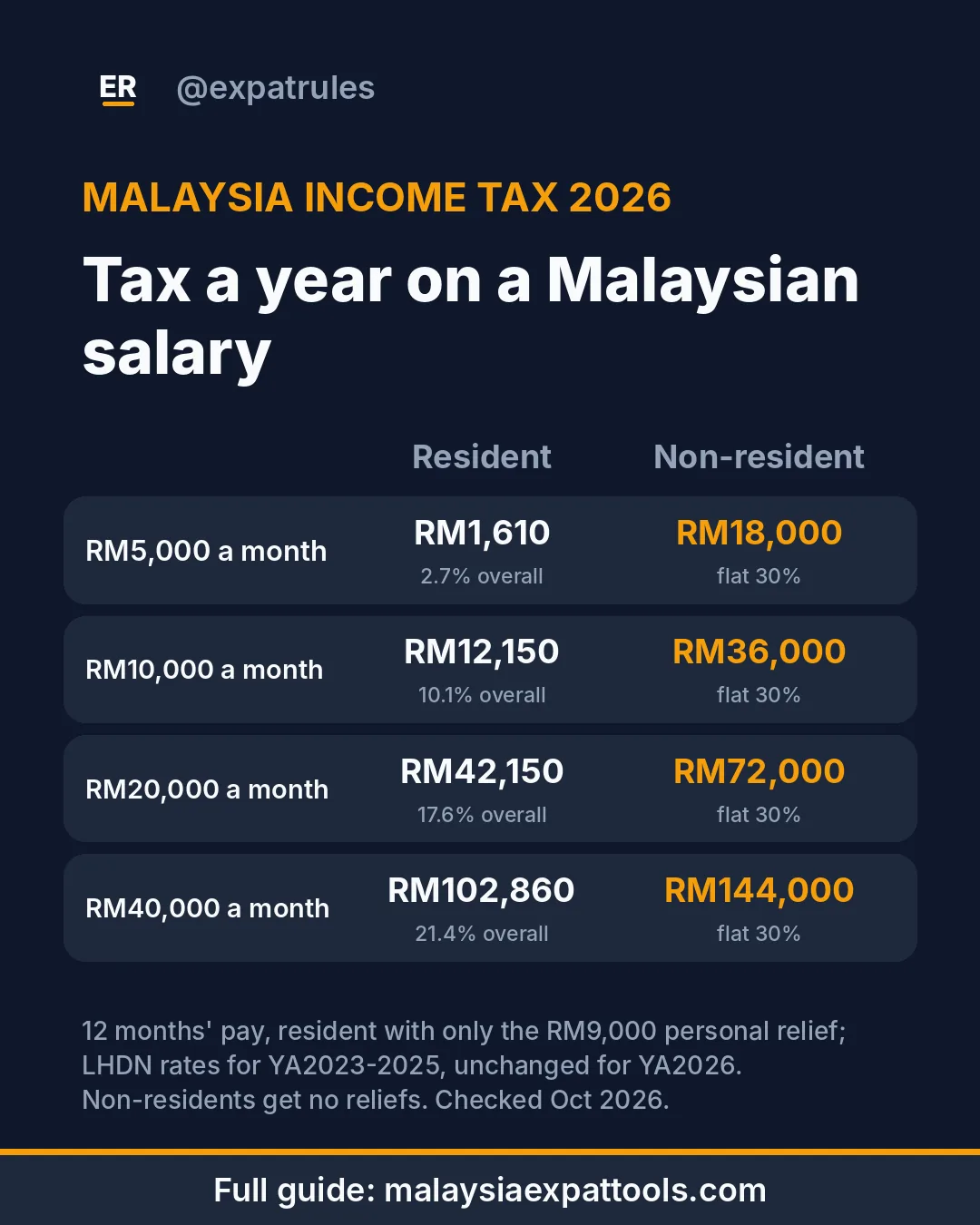
Estimate your Malaysian income tax →Foreigners who are Malaysian tax residents pay 0% to 30% on income after reliefs, the same rates as Malaysians. Non-residents pay a flat 30% on Malaysian employment income, with no reliefs. On RM10,000 a month, that is about RM12,150 a year for a resident against RM36,000 for a non-resident.
Malaysia taxes income that comes from Malaysia, and how much you pay depends mostly on one thing: whether you are a tax resident that year. Residents pay progressive rates and get reliefs. Non-residents pay a flat 30% on Malaysian employment income. This guide uses the Inland Revenue Board (LHDN) tables.
The short answer
- Residents (usually 182 days or more in Malaysia in the calendar year) pay 0% to 30% on chargeable income, after reliefs.
- Non-residents pay a flat 30% on employment income, with no reliefs and no rebate.
- Work done in Malaysia is Malaysian income, even if a foreign company pays you into a foreign account.
- Foreign income brought into Malaysia is exempt for resident individuals until 31 December 2036, under conditions. Non-residents are not taxed on it.
Resident vs non-resident at a glance
| Resident | Non-resident | |
|---|---|---|
| Rate on employment income | 0% to 30% on chargeable income | Flat 30% |
| RM9,000 individual relief and other reliefs | Yes | No |
| RM400 rebate | If chargeable income is RM35,000 or less | No |
| Monthly deduction by the employer (PCB/MTD) | Scale rates | 30% of pay |
| Employment in Malaysia of 60 days or less in the year | Taxed as normal | Exempt |
| Foreign income brought into Malaysia | Exempt under conditions | Not taxed |
| Tax return form (salary income) | BE | M |
LHDN’s own summary of the two treatments is the source for the rate, relief and rebate rows.
Not sure which you are? The tax residency guide explains the four tests, and the 182-day counter adds up your days.
The resident tax table
LHDN publishes these rates for the years of assessment 2023, 2024 and 2025. Budget 2026 did not change them, so they also apply to 2026 income (year of assessment 2026). LHDN had not posted a separate 2026 table when we checked in October 2026.
| Chargeable income (RM) | Rate | Tax on the bands below (RM) |
|---|---|---|
| 0 to 5,000 | 0% | 0 |
| 5,001 to 20,000 | 1% | 0 |
| 20,001 to 35,000 | 3% | 150 |
| 35,001 to 50,000 | 6% | 600 |
| 50,001 to 70,000 | 11% | 1,500 |
| 70,001 to 100,000 | 19% | 3,700 |
| 100,001 to 400,000 | 25% | 9,400 |
| 400,001 to 600,000 | 26% | 84,400 |
| 600,001 to 2,000,000 | 28% | 136,400 |
| Over 2,000,000 | 30% | 528,400 |
“Chargeable income” is your income after reliefs. Each rate applies only to the part of your income inside that band.
Reliefs and the rebate (residents only)
| Item | Amount |
|---|---|
| Individual relief, automatic | RM9,000 |
| Spouse with no income who does not file separately | RM4,000 |
| Each unmarried child under 18 | RM2,000 |
| EPF (KWSP) contributions | up to RM4,000 |
| Rebate if chargeable income is RM35,000 or less | RM400 off the tax |
There are more reliefs, for medical costs, lifestyle purchases, insurance and others: see the full list in Malaysia tax relief for expats. The income tax calculator lets you add them.
Worked examples
These assume 12 months of pay, resident status and only the RM9,000 individual relief.
- RM5,000 a month (RM60,000 a year). Chargeable income RM51,000. Tax = RM1,500 on the first RM50,000 + 11% of RM1,000 = RM1,610, about 2.7% of pay. As a non-resident: 30% of RM60,000 = RM18,000.
- RM10,000 a month (RM120,000). Chargeable income RM111,000. Tax = RM9,400 + 25% of RM11,000 = RM12,150, about 10.1%. Non-resident: RM36,000.
- RM20,000 a month (RM240,000). Chargeable income RM231,000. Tax = RM9,400 + 25% of RM131,000 = RM42,150, about 17.6%. Non-resident: RM72,000.
| Monthly salary | Resident: tax a year | Effective rate | Non-resident: tax a year |
|---|---|---|---|
| RM3,000 | RM0 | 0.0% | RM10,800 |
| RM5,000 | RM1,610 | 2.7% | RM18,000 |
| RM8,000 | RM6,930 | 7.2% | RM28,800 |
| RM10,000 | RM12,150 | 10.1% | RM36,000 |
| RM15,000 | RM27,150 | 15.1% | RM54,000 |
| RM20,000 | RM42,150 | 17.6% | RM72,000 |
| RM30,000 | RM72,150 | 20.0% | RM108,000 |
| RM50,000 | RM134,060 | 22.3% | RM180,000 |
The same assumptions apply: 12 months of pay, resident figures with only the RM9,000 individual relief.
RM5,000, RM10,000 and RM20,000 a month are also the lowest basic salaries for the three Employment Pass categories, so these are realistic first-year numbers for many expat hires.
With family reliefs
A resident on RM15,000 a month (RM180,000) with a spouse who has no income, two children under 18, RM4,000 of EPF contributions and RM3,000 of life insurance premiums claims RM24,000 of reliefs: RM9,000 + RM4,000 + 2 × RM2,000 + RM4,000 + RM3,000. Chargeable income is RM156,000, so the tax is RM9,400 + 25% of RM56,000 = RM23,400 (13.0%), against RM27,150 with the individual relief alone.
Where the rebate wipes out the tax
On RM3,000 a month (RM36,000), chargeable income is RM27,000. The tax on that is RM150 + 3% of RM7,000 = RM360, and the RM400 rebate (for chargeable income of RM35,000 or less) cancels it, so a resident pays nothing. With only the individual relief, a resident pays no tax on a salary up to about RM37,333 a year. A non-resident on the same RM3,000 a month pays RM10,800.
A non-resident on a short assignment
LHDN’s own example: a non-resident employee on RM10,000 a month has RM3,000 deducted every month (30%), and if that covers the tax for the year, nothing more is due on the return. If the employment in Malaysia lasts 60 days or less in the calendar year, the employment income is exempt altogether. LHDN counts days of employment for this test, so 61 days of employment in Malaysia is fully taxable.
Your first and last year
Residency is decided year by year. If you arrive in September, you may have fewer than 182 days in your first calendar year and be taxed as a non-resident for those months, even though you will be resident from the next year. Employers often deduct 30% from a new arrival’s pay until the 182 days are reached; in LHDN’s example the deduction switches to the scale rates once the employee has been in Malaysia for 182 days in the year, and the tax return settles any difference. The linked-stay rule can sometimes make that first year resident too: see the residency guide. Your last year works the same way in reverse.
Foreign income
Under an exemption order now extended to 31 December 2036 (P.U.(A) 451/2024), resident individuals do not pay Malaysian tax on most foreign income they bring into Malaysia: overseas pensions, dividends, interest, rent and similar. LHDN’s guidelines require the income to have been subject to tax in the country it came from, and the exemption does not cover foreign income received through a Malaysian partnership. The foreign income exemption checker walks through the conditions.
Remote workers should note the difference: salary for work you do while in Malaysia is Malaysian income, not foreign income, wherever your employer is.
What Budget 2027 proposes
Budget 2027, tabled on 9 October 2026, proposes for resident individuals from the 2027 year of assessment:
- individual relief up from RM9,000 to RM12,000;
- 18% instead of 19% on chargeable income from RM70,001 to RM100,000;
- a new 24% band from RM100,001 to RM150,000;
- the top 30% rate starting at RM1 million instead of RM2 million.
These are proposals until the Finance Bill is passed by Parliament. The Finance Bill 2026, which carries them, was tabled for its first reading in the Dewan Rakyat on 16 November 2026. As of 28 November 2026 it has not been passed, so this guide and the calculator use the current rates. We will update both once the changes are enacted.
Before you rely on it
Employers deduct tax every month through PCB (monthly tax deduction), which can differ from your final bill. Your annual return settles the difference. For anything complex, such as share options, rental income or a mid-year move, check with LHDN or a tax adviser.
Sources
- LHDN: Tax rates (last updated 26 June 2026)
- LHDN: Tax reliefs
- LHDN: Tax treatment of residents and non-residents (flat 30%, no reliefs or rebate for non-residents, 60-day exemption)
- LHDN: Tax and expatriates (non-resident monthly deduction at 30%, first-year example)
- LHDN: Residence Status
- LHDN: Guidelines on tax treatment of income received from abroad (amendment, June 2024)
- Bloomberg Tax: Malaysia gazettes order extending the foreign income exemption (P.U.(A) 451/2024)
- PwC Worldwide Tax Summaries: Malaysia, taxes on personal income
- Bernama: Finance Bill 2026 tabled for first reading (16 November 2026)
- EY Take 5: Malaysia Budget 2027 (proposals for YA2027)
Frequently asked questions
What is the income tax rate for foreigners in Malaysia?
It depends on tax residence, not nationality. A foreigner who is a tax resident (usually 182 days or more in Malaysia in the calendar year) pays the same progressive rates as Malaysians, from 0% to 30% on chargeable income after reliefs. A non-resident pays a flat 30% on Malaysian employment income, with no reliefs and no rebate.
How much tax does a foreigner pay on RM10,000 a month in Malaysia?
As a resident with only the RM9,000 individual relief, about RM12,150 a year (10.1% of pay). As a non-resident, a flat 30%: RM36,000 a year, and the employer deducts RM3,000 a month.
Do foreigners get the RM9,000 personal relief?
Yes, if they are tax resident for the year. Reliefs and the RM400 rebate depend on residence, not citizenship. Non-residents get no reliefs and no rebate.
Is employment income tax free if I work in Malaysia for less than 60 days?
For a non-resident, yes: employment income is exempt if the employment in Malaysia does not exceed 60 days in the calendar year, under paragraph 21 of Schedule 6 to the Income Tax Act 1967. LHDN counts the days of employment in Malaysia. If you go over 60 days and stay non-resident, the whole Malaysian employment income is taxed at 30%.
I arrived in Malaysia mid-year. Am I taxed as a non-resident?
Only if you end the calendar year with fewer than 182 days and none of the other residence tests applies. Your employer often deducts 30% until you pass 182 days; if you are resident for the year, your tax return settles the difference. A stay of 182 days in a row that runs across the year end can make the first year resident too.
Will Malaysian tax rates change in 2027?
Budget 2027 proposes a higher RM12,000 individual relief, 18% instead of 19% on RM70,001 to RM100,000, a new 24% band from RM100,001 to RM150,000 and the 30% top rate from RM1 million, all from the 2027 year of assessment. As of 28 November 2026 the Finance Bill carrying them has not been passed, so 2026 income is taxed at the current rates.
This guide is general information, not legal or tax advice. Rules change, so confirm with the Immigration Department, LHDN or a professional.