Malaysia Tax Relief for Expats: What Foreigners Can Claim (YA2025)
Updated Sat, 28 November 2026
See how reliefs change your tax →Foreigners who are Malaysian tax residents can claim the same tax reliefs as Malaysians: RM9,000 automatically, plus reliefs for a spouse, children, EPF and life insurance, medical costs and lifestyle spending. Non-residents cannot claim any. This guide lists the reliefs expats use most, from the Inland Revenue Board (LHDN) list for the 2025 year of assessment, and shows what they save.
Who can claim
Reliefs follow tax residence, not nationality. LHDN’s guidance for expatriates says a resident pays the scale rates of 0% to 30% on chargeable income after reliefs, while a non-resident is “not entitled to claim for reliefs” and pays a flat 30%. The RM400 rebate is also for residents only.
You are usually resident if you spend 182 days or more in Malaysia in the calendar year, and three other tests can make you resident with fewer days. Check with the 182-day tax residency counter or read the tax residency guide.
The reliefs expats use most
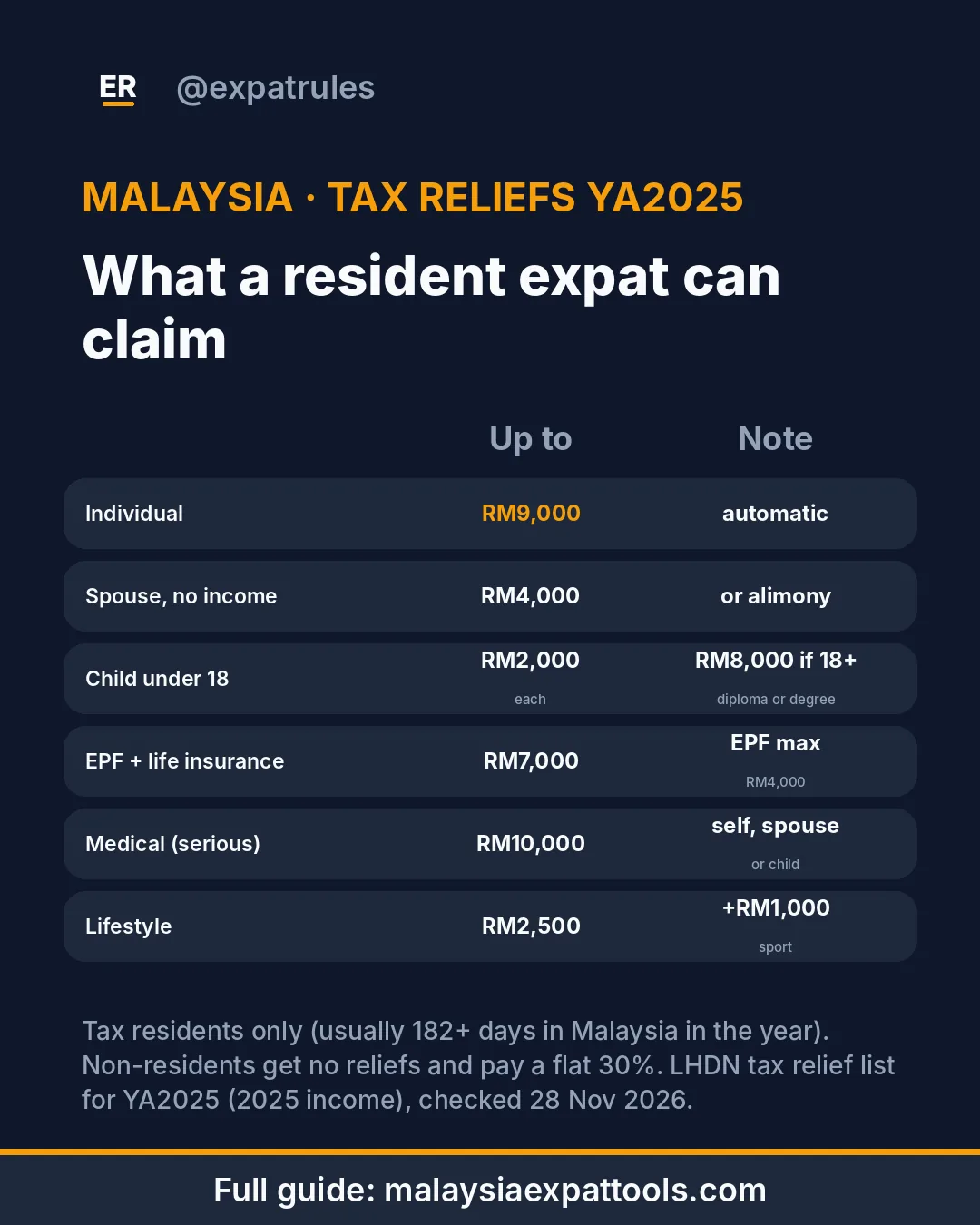
These are the amounts on LHDN’s list for YA2025 (income earned in 2025, filed in 2026). Most are caps: you claim what you actually spent, up to the limit.
| Relief | Up to (RM) | What it covers |
|---|---|---|
| Individual | 9,000 | Automatic for every resident |
| Spouse | 4,000 | Husband or wife (or alimony to a former wife) |
| Each unmarried child under 18 | 2,000 | Per child |
| Each unmarried child 18+ in full-time study | 2,000 | A-Level, certificate, matriculation or preparatory courses |
| Each unmarried child 18+ in higher education | 8,000 | Diploma or higher in Malaysia, or a degree or higher abroad, at an approved institution |
| EPF and life insurance | 7,000 | EPF and other mandatory or approved contributions up to 4,000; life insurance or family takaful up to 3,000 |
| Education and medical insurance | 4,000 | Premiums for policies with education or medical benefits |
| Medical expenses | 10,000 | Serious diseases, fertility treatment, vaccination (up to 1,000) and dental treatment (up to 1,000) for you, your spouse or child |
| Medical checks | within the 10,000 above | Full medical examination, mental health consultation, health monitoring equipment and disease tests, up to 1,000 in total |
| Parents’ medical care | 8,000 | Medical, dental and carer costs for parents or grandparents; full medical examination up to 1,000 |
| Lifestyle | 2,500 | Books and publications, a computer, smartphone or tablet, internet bills in your name, skills courses |
| Sport | 1,000 | Sports equipment, gym membership, facility fees, competition entry |
| Child care | 3,000 | Registered child care centre or kindergarten, child aged 6 or under |
| Your own education fees | 7,000 | Approved courses, including any master’s or doctorate; upskilling courses up to 2,000 |
| SOCSO contributions | 350 | Your own contributions |
| Private retirement scheme and deferred annuity | 3,000 | Approved schemes |
The full LHDN list has more items, for disability, breastfeeding equipment, electric vehicle charging, the national education savings scheme (SSPN) and first-home loan interest. Each has its own conditions, so read the LHDN page before you claim them.
What a relief actually saves
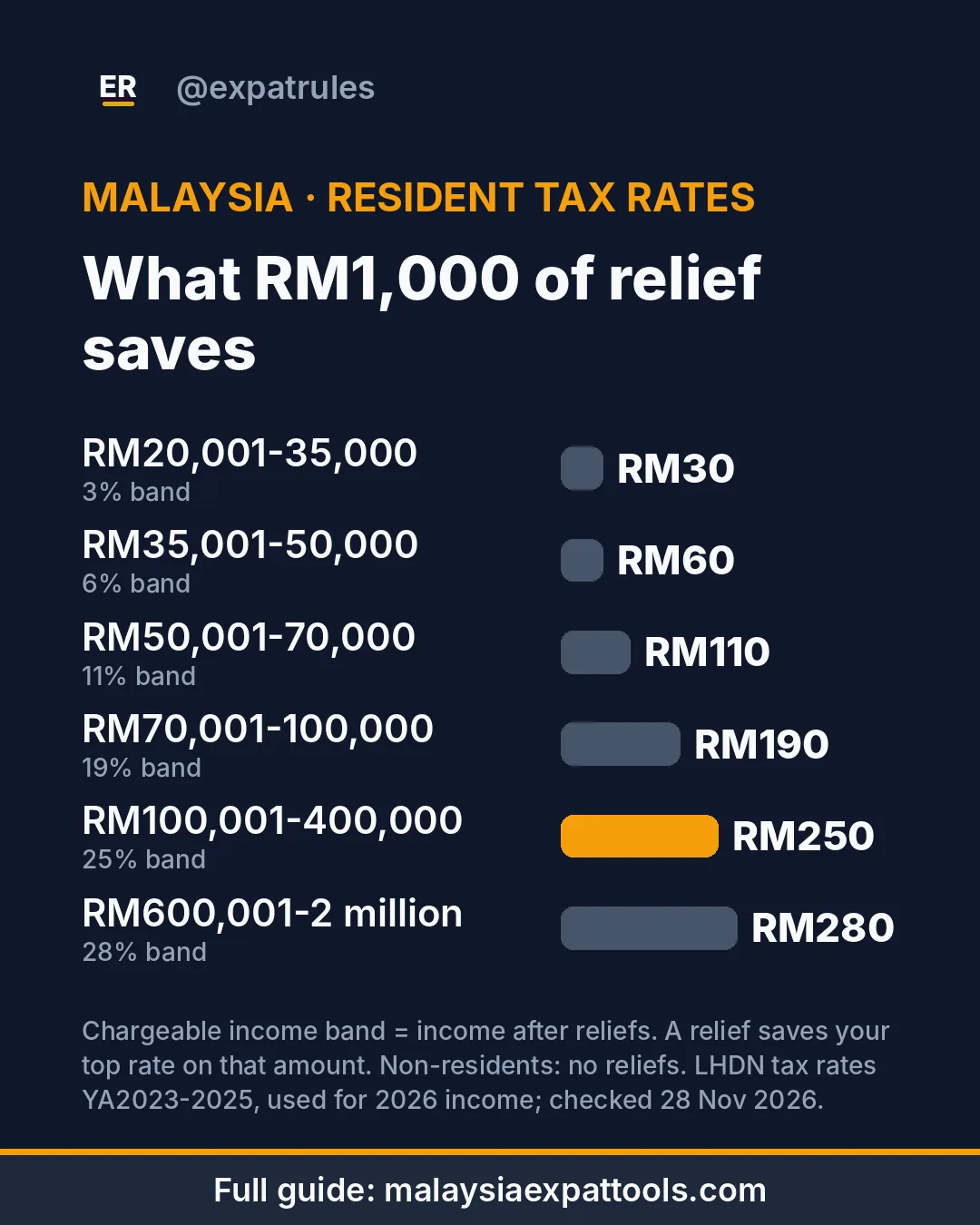
A relief is taken off your income before tax is worked out, so it saves your top rate on that amount, not the full amount. Each RM1,000 of relief saves RM60 if your chargeable income is in the 6% band, RM190 in the 19% band and RM250 in the 25% band (RM100,001 to RM400,000), which is where many expat salaries sit.
Example: RM10,000 a month (RM120,000 a year). With only the RM9,000 individual relief, chargeable income is RM111,000 and the tax is RM12,150. Now add RM2,500 of lifestyle spending, RM1,000 of sport, a RM1,000 health check and RM3,000 of medical insurance premiums: RM7,500 more relief. Chargeable income falls to RM103,500 and the tax to RM9,400 + 25% of RM3,500 = RM10,275. The extra reliefs save RM1,875, because all RM7,500 came off the 25% band.
Example: a family on RM15,000 a month (RM180,000). A spouse with no income, two children under 18, RM4,000 of EPF and RM3,000 of life insurance give RM24,000 of reliefs. The tax is RM23,400 instead of RM27,150 with the individual relief alone. The income tax calculator lets you enter your own reliefs.
For low incomes, the RM400 rebate matters more than extra reliefs: a resident with chargeable income of RM35,000 or less has RM400 taken off the tax, which on its own clears the tax on a salary of up to about RM37,333 a year.
Things expats get wrong
- Claiming in a non-resident year. If your first or last calendar year in Malaysia is under 182 days and no other test applies, you pay 30% with no reliefs that year, even if you are resident the year after. See Malaysia income tax for foreigners.
- Skipping the conditions. Several items have conditions that matter for families who moved from abroad: higher education relief needs an institution approved by the relevant government authority, child care relief needs a registered child care centre or kindergarten, and parents’ medical costs need a medical condition certified by a practitioner. Check each item’s conditions on the LHDN page before you claim.
- Forgetting the combined caps. EPF and life insurance share one RM7,000 limit. Vaccination, dental treatment and medical checks sit inside the RM10,000 medical limit, each with its own RM1,000 sub-limit.
- Mixing up years. This list is for YA2025. LHDN had not published a separate YA2026 list when we checked on 28 November 2026.
How to claim
You claim reliefs in your annual return. For salary income that is Form BE, filed online through MyTax by 30 April of the following year. Keep receipts in case LHDN asks for them. Non-residents file Form M and claim nothing. The tax return guide for foreigners covers forms and deadlines.
What Budget 2027 proposes
Budget 2027 proposes raising the individual relief from RM9,000 to RM12,000 from the 2027 year of assessment, alongside changes to the rate bands. It needs the Finance Bill, tabled for first reading on 16 November 2026, to be passed. As of 28 November 2026 it has not been, so the RM9,000 figure stands.
Sources
- LHDN: Tax reliefs (YA2025 list, last updated 26 June 2026)
- LHDN: Tax rates (YA2023 to 2025 table, last updated 26 June 2026)
- LHDN: Tax and expatriates (non-residents not entitled to reliefs; flat 30%)
- LHDN: Tax treatment of residents and non-residents (reliefs and rebate for residents only)
- LHDN: Residence Status
- Bernama: Finance Bill 2026 tabled for first reading (16 November 2026)
- EY Take 5: Malaysia Budget 2027 (proposals for YA2027)
Frequently asked questions
Can foreigners claim tax relief in Malaysia?
Yes, if they are tax resident for the year, which usually means 182 days or more in Malaysia in the calendar year. Reliefs depend on tax residence, not citizenship. Non-residents cannot claim any reliefs and pay a flat 30% on Malaysian employment income.
What is the personal tax relief in Malaysia for 2025?
Every resident individual gets RM9,000 automatically for the 2025 year of assessment. On top of that come reliefs such as RM4,000 for a spouse with no income, RM2,000 for each unmarried child under 18, up to RM7,000 for EPF and life insurance, up to RM10,000 for serious medical expenses and RM2,500 for lifestyle purchases.
Can I claim EPF relief as a foreigner?
If you are tax resident and make EPF contributions, they count toward the relief for mandatory, voluntary or approved-scheme contributions, capped at RM4,000. Life insurance premiums share a combined RM7,000 limit with EPF, with their own RM3,000 sub-limit.
Can I claim relief for my child studying abroad?
LHDN's YA2025 list gives RM8,000 for each unmarried child aged 18 or over studying for a degree or higher outside Malaysia, or a diploma or higher in Malaysia, at an institution approved by the relevant government authority. Children under 18 get RM2,000 each.
How much tax does a relief save?
A relief lowers your chargeable income, so it saves your top tax rate on that amount. RM1,000 of relief saves RM60 if your chargeable income is in the 6% band, RM190 in the 19% band and RM250 in the 25% band.
Will the RM9,000 personal relief go up?
Budget 2027 proposes raising it to RM12,000 from the 2027 year of assessment. As of 28 November 2026 the Finance Bill carrying the change has not been passed, so RM9,000 still applies.
This guide is general information, not legal or tax advice. Rules change, so confirm with the Immigration Department, LHDN or a professional.