Malaysia Long-Stay Visas Compared (2026): DE Rantau vs Employment Pass vs MM2H vs PVIP
Updated Sat, 14 November 2026
Find the pass that fits you →Malaysia has no single “long-stay visa”. Which pass you need depends on how you earn your money and how long you want to stay: a remote job, a Malaysian employer, savings, or a very high income. This guide puts the four main routes side by side with the official 2026 figures, so you can see which one to look at first.
The short answer
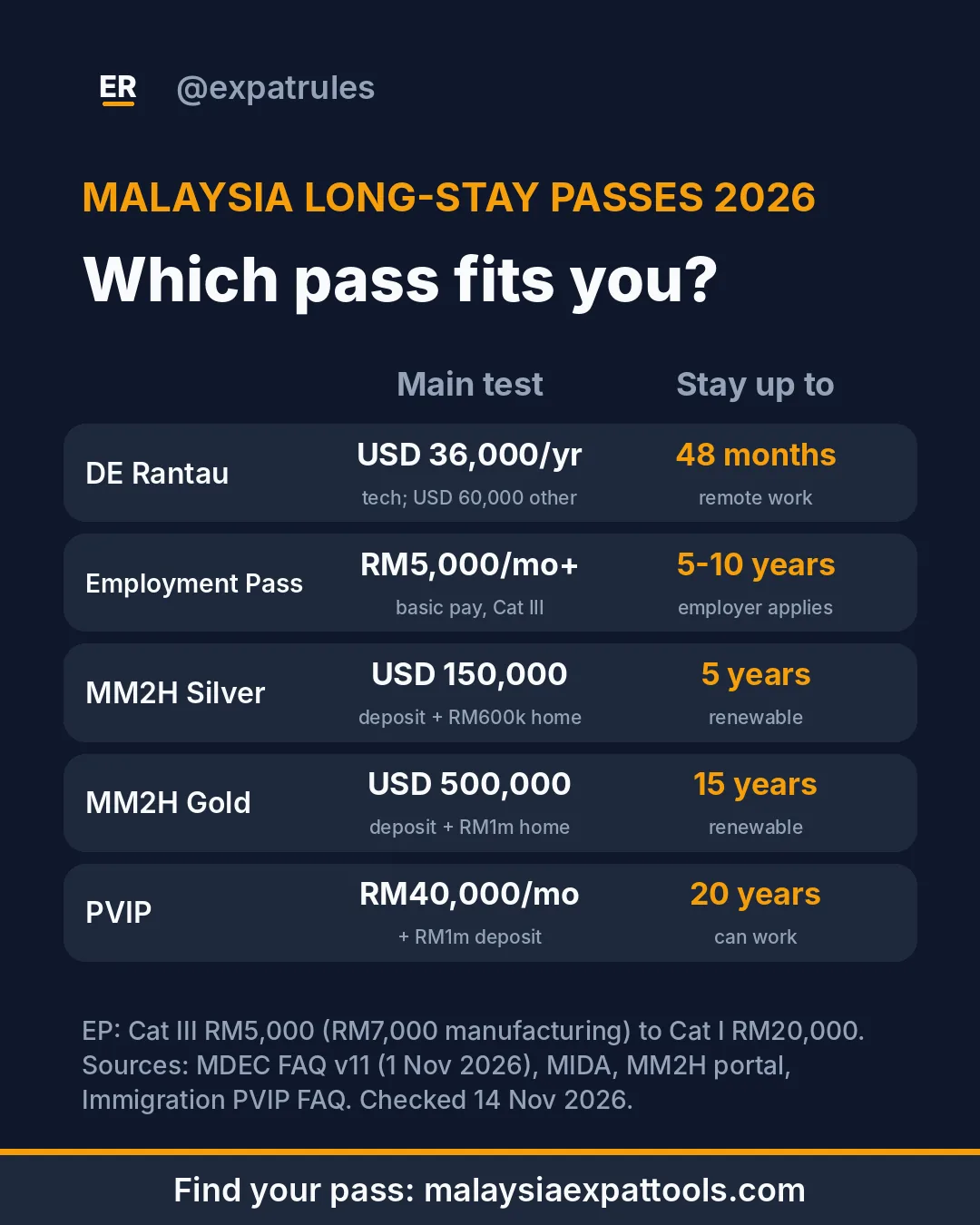
| If you… | Look at | Main test | Stay |
|---|---|---|---|
| Work remotely for clients or an employer outside Malaysia | DE Rantau | USD 36,000 a year (tech roles) or USD 60,000 (other work) | 3 to 12 months, renewable to 48 months |
| Have a job offer from a Malaysian company | Employment Pass | Basic salary from RM5,000 a month (Category III) | Up to 5 years (Cat III) or 10 years (Cat I and II) |
| Have savings and want to live in Malaysia without working | MM2H | Fixed deposit from USD 150,000 plus a home from RM600,000 | 5, 15 or 20 years by tier |
| Earn a very high income and want to work and invest | PVIP | RM40,000 a month and a RM1,000,000 deposit | Up to 20 years |
Not sure which describes you? The Malaysia visa finder asks a few questions and shows the passes that fit, including the Residence Pass-Talent, Sarawak’s own MM2H and the spouse pass, which this guide does not cover.
DE Rantau: for remote workers
The DE Rantau nomad pass, run by MDEC, is for people aged 18 or over who work remotely for a company outside Malaysia or freelance for foreign clients. You need a contract that started at least 3 months before you apply.
- Income: USD 36,000 a year for digital and tech roles, USD 60,000 for other roles.
- Stay: 3 to 12 months at first, then up to three 12-month renewals, so 48 months at most.
- Cost: RM1,080 processing fee (RM540 per dependant) and an Immigration pass fee of RM90 for every 3 months, plus a refundable bond of RM200 to RM2,000 depending on nationality.
- Family: spouse, children and parents can join you, but dependants cannot work.
DE Rantau is for work for clients and employers outside Malaysia; for a job with a Malaysian company, look at the Employment Pass. Details: DE Rantau requirements.
Employment Pass: for a job in Malaysia
If a Malaysian company hires you, the employer applies for your Employment Pass; you cannot apply on your own. Since 1 June 2026 applications go through MIDA’s Expatriate System, and the employer must first advertise the job on MYFutureJobs for at least 14 working days.
| Category | Minimum basic salary a month | Total time on the category |
|---|---|---|
| I | RM20,000 | Up to 10 years |
| II | RM10,000 | Up to 10 years |
| III | RM5,000 (RM7,000 in manufacturing) | Up to 5 years |
Only basic salary counts, not allowances. Holders in all three categories can bring dependants. Category II and III employers need a localisation or succession plan, and MIDA has said the succession plan requirement takes effect from 1 January 2027. Budget 2027 also announced that from 1 January 2027 spouses of Category I holders who meet the criteria can apply to work. Details: Employment Pass salary rules.
MM2H: for savings, not salary
Malaysia My Second Home has no income test. Instead you place a fixed deposit in a Malaysian bank and buy a home you keep for at least 10 years.
| Tier | Fixed deposit | Minimum home | Pass | Participation fee |
|---|---|---|---|---|
| Silver | USD 150,000 | RM600,000 | 5 years | RM1,000 |
| Gold | USD 500,000 | RM1,000,000 | 15 years | RM3,000 |
| Platinum | USD 1,000,000 | RM2,000,000 | 20 years | RM200,000 |
All three tiers need you to be at least 25. On top of the participation fee there is a RM5,000 processing fee (RM2,500 per dependant) and a pass fee of RM500 a year. If you are under 50, you and your family must spend at least 90 days a year in Malaysia. After approval you can take out up to 50% of the deposit for your home, education, medical costs or travel in Malaysia.
The state minimum price for foreign buyers also applies, and in many states it is higher than the Silver minimum. A Special Zone tier for Forest City in Johor needs less money. Details: MM2H requirements and minimum property prices by state.
PVIP: for very high earners
The Premium Visa Programme (PVIP) is run by the Immigration Department. Its FAQ says PVIP holders are allowed to work and study in Malaysia.
- Income: RM40,000 a month (RM480,000 a year) from Malaysia and abroad combined, or a net worth of at least RM1 billion.
- Deposit: RM1,000,000 fixed deposit with a licensed Malaysian bank.
- Fees: RM2,000 at registration, then a participation fee of RM200,000 for you and RM100,000 for each dependant (or RM50,000 for a dependant who takes a 10-year pass instead of 20).
- Stay: up to 20 years, with no minimum or maximum age.
- How to apply: only through PVIP agencies appointed by Immigration.
What each one costs in year one
Fees only, for one person, before visa fees that depend on your nationality. Deposits and homes are not included because you keep them.
| Pass | Government fees in year one |
|---|---|
| DE Rantau, 12 months | About RM1,440 (RM1,080 + 4 × RM90), plus the bond |
| Employment Pass | Usually paid by the employer |
| MM2H Silver | About RM6,500 (RM5,000 + RM1,000 + RM500) |
| PVIP | RM202,000 (RM2,000 + RM200,000) |
Tax is a separate question
None of these passes decides your tax. Spending 182 days or more in Malaysia in a calendar year can make you a tax resident whatever pass you hold. How foreign income you bring in is treated is a separate check. See the 182-day tax residency counter and the foreign income exemption checker.
Rules and fees change often, so confirm with the agency that runs each pass (MDEC, MIDA, MOTAC or Immigration) before you apply.
Sources
- MDEC: DE Rantau Pass FAQ, version 11.0 (1 November 2026)
- MIDA: implementation of the new expatriate employment policy (EP categories from 1 June 2026; dependants in all categories)
- MIDA: strengthening Malaysia’s expatriate framework (18 August 2026) (MYFutureJobs advertising, MIDA Expatriate System)
- MIDA: phased implementation of the succession plan requirement (from 1 January 2027)
- MIDA: announcements (Budget 2027 media release of 12 October 2026: work permission for spouses of Category I holders from 1 January 2027)
- MM2H portal: category overview and guidelines (checked 12 November 2026)
- MOTAC: MM2H terms and regulations for new participants
- Immigration Department: PVIP general FAQ
This guide is general information, not legal or tax advice. Rules change, so confirm with the Immigration Department, LHDN or a professional.